Saturday, December 28, 2013

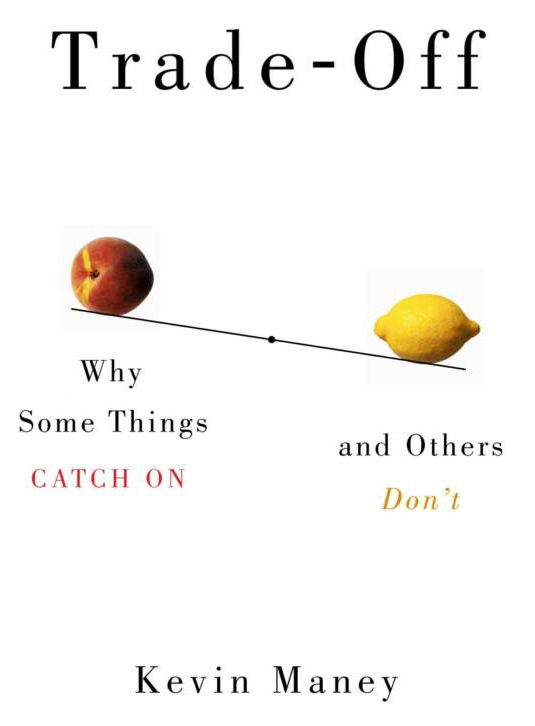
Trade-Off: Why Some Things Catch On, and Others Don't by Kevin Maney
Broadway Books, NY-USA, 2009

To put the book in a single line would be to say that, in order to be successful, businesses should either be high in Fidelity or in Convenience. Fidelity meaning a product that is premium, priced at a soaring rate and is hard to get – and its customers are ready to buy it at the rated price, go all out to get the product, feel its aura and the experience from the brand. A fidelity product adds to the buyer's personality. For ex: Merceds. On the other hand, convenience means a product or a brand that is cheaply priced and is easily available and its customers buy the product because of its low price and its convenience. For ex: McDonalds.

In order to grow, businesses are required to trade-off one thing or the other. Maney puts that businesses can either be high on fidelity (quality) or high on convenience (low cost) – no business can be high on both ends. A business that tries to address both ends, ends up in what Maney calls the “fidelity mirage” or lands up in the “fidelity belly”. An example could be that of the high-end brand Coach that manufactures classy handbags – it got into a fidelity mirage when it started selling cheap bags at a lower prices in malls. A fidelity mirage is something like trying to reach the sky and getting to the earth at the same time. For example, Starbucks illustrates the perfect case of a businesses in the fidelity belly. Starbucks started off as a high fidelity brand and had its own aura. People would shed more bucks to have coffee at Starbucks until it started its aggressive expansion – to put a Starbucks in every city on every corner. The aura that it had, started to diminish as it became more familiar – people did not want to shed more money for a cup of coffee from the corner shop and the brand landed into the fidelity belly. Fidelity and convenience act like antimatter to each other, says Maney. This idea may seem over simplified and ocuurs in every chapter and example in the book. A business needs to concentrate on its core audience and their needs to in order to grow.

Maney's ideas are simple to understand and easy to use in any business setting – be it a established company or a start-up. The trade-off model can be used as a quick-check when making decisions. The book is worth a read.

Monday, September 9, 2013

(book review) Adland


Adland: A Global History of Advertising by Mark Tungate
(Kogan Page, London and Philadelphia, 2007)

Most of the books on advertising seem to come from agencies that promote their own agenda. With Adland, Tungate brings a true journalistic style, an outside perspective... exploring facts, dreams and desires that made the ad world what it is today. This book is not a trumpet for any agency but is a well researched piece that walks the reader through each era in advertising history and explores future of the industry. 

Mark Tungate, an author and journalist explores the development of advertising from an international perspective. The book is a journey through highlights in the history and development of some of the biggest media agencies worldwide. Tungate explores the evolution of some of the key names in the industry such as WPP, Omnicom, Saatchi and Saatchi, Interpublic, Publicis, Havas, Dentsu and more... The book includes interviews of some of the industries stars such as George Lois, Tom Bernadin, Sir Alan Parker, Jean-Marie Dru, Sir Martin Sorrell, John Hegarty and Phil Dusenberry. This book is a must read for anyone in the field of advertising, marketing or related. Knowing these stories inside-out will give you a strong perspective of how and why the adworld is the way it is.

Monday, April 29, 2013

(book review) Outside Innovation

Outside Innovation: How your customers will Co-Design your Company's Future by Patricia B. Seybold
(Harper Collins Publishers, NY-USA, 2006)

Open innovation, co-design, crowd sourcing... I have always been hunting down books that talk about these topics. This book covers all these concepts and even more.  

With the advent of the internet age, there has been a fundamental shift in power that has put the customers in the driver's seat. With a plethora of choices and access to information at their fingertips, customers are now able to compare your company's products, prices, features and demand what they exactly want. Generic products are no longer what they seek. Customization is the new norm. Even though companies understand this change and research consumers and their needs, most face challenges in implementing what the consumers exactly want. Patricia Seybold has the answer - co-innovate! Seybold explains why companies today win by not just hiring the smartest talent, but they win by engaging with the smartest consumer.

Through case-studies from companies such as LEGO, Hallmark and Staples, Seybold walks the reader through the process of co-innovation. She talks about how many companies already engage directly with their "lead users" (customers who are passionate about the products) and their ideas to co-design solutions that will better meet their own (customer's) needs. The author talks about how eBay created a new industry by enabling sellers to find buyers” and "Dell made build-to-order standard operating procedure" through co-innovation. She discusses how these companies succeeded not by just creating a generic product out of R&D. They won by co-creating with their customers. 

Interesting read!

Wednesday, January 2, 2013

(book review) The LongTail

The LongTail: Why The Future of Businesses Is Selling Less of More by Chris Anderson
(Hyperion, NY-USA, 2006)

I studied the economics of the Long Tail when I was working on strategies for Netflix earlier this year. Chris Anderson wrote an article on the topic in October 2004. The article featured in Wired Magazine. Anderson's concept was the corner stone for my recommendations to the Netflix execs. Since then, I have wanted to read "The Long Tail". 

It has been a few months since and I finally got my hands on this book. I picked it up right after my graduation and I am so glad that the book was everything it promised. I guess I may be late in picking up this book and a lot of you must have already taken the pleasure. Obviously, some of the material seemed a bit outdated to me as it has been a few years since it was first published. But, reading and understanding the principles opened up some new avenues.

Long tail as a concept comes from the Pareto principle (80/20 rule) or the power law. It basically means that 80% of the the effect comes from 20% of causes. In business terms, 80% of the sales come from 20% of the products. Hits are rare - But this does not necessarily mean they are the best. It just means that they are the biggest. Similarly, the flops or products in the tail aren't necessarily bad products. As a matter of fact, all the products have buyers (even though the numbers decrease significantly). Hits may attract the majority but the tails attract niches. The book talks about how Internet has changed the economics of supply and demand. The book revolves around the idea that lesser known or less popular products in total account for a huge amount of sales in comparison with just the hit few. This does not mean we undermine the hits but just that we also focus our attention on the tail.

Even though the Long tail wave may have lost its novelty in the US, we see that the phenomenon is yet to fully bloom in places like India.

Anderson's article was released a couple of years before he published this book. The book is not bad, but the article makes you fall in love with the concept.
Seth Godin wrote an interesting article on the same topic last month. Click here to read his article. For additional reading, I recommend 'Wikinomics' along or before reading this book.

Monday, November 19, 2012

(book review) Starbucked

Starbucked: A Double Tall Tale of Caffeine, Commerce and Culture by Taylor Clark
(Little, Brown and Company, NY-USA, 2007)

For all you coffee lovers out there and the rest of you, Taylor Clark has written this fun piece of Starbuck's birth, its growth and its journey that will educate and humour you at the same time.

The first part of the book talks about how Starbucks changed economics of the coffee industry. It talks about the history of coffee and the culture surrounding it. The second part contains discussion around the controversies surrounding Starbucks. The criticism points how Starbucks has homogenized the planet, destroyed cultural diversity within its stores, killed the local coffee houses and how they have underpaid the farmers. This author has managed to maintain a good balance of the positive and negative aspects of the company. Overall, its a great research and analysis on the impact that Starbucks has on all our lives.

With my background, I enjoyed reading how they developed their brand, the history of the Mermaid logo and how it evolved. I liked to learn about their approach to retail design and the impact it has on the customers. Clark's research and his journalistic style of writing appealed to me. I encountered this same (journalistic) style of writing with Sarah Lacy's book (review below) and seem to enjoy it.

Even though I found it hard to separate Howard Schultz from Starbucks throughout the book, I still have an appetite for more. The next book I want to read now is Onward: How Starbucks Fought for its Life without losing its Soul by Howard Schultz.

Friday, October 19, 2012

Crowd-funding is here to stay!

Seth Godin made big waves earlier this year when he announced the crowd-funding campaign for his new book. He reached his $40,000 target in barely a few hours and passed way ahead of the set goal. Even though crowd-funding as a concept is not really new, the last few years have shown a spurt in the adoption of this concept.

Last month, I was in the beginning stages of writing a strategic plan for Kiva.org and was interviewing Matt Flannery for deeper insights on the business model. Kiva is the world's first and the largest person-to-person micro-lending website and has helped over 800,000 people through small loans from lenders. Since Kiva, a number of other philanthropic organizations have taken up crowd-funding as a way to collect larger amounts of money to help their causes.

Crowd-funding solves the problem of access to money by tapping into individuals for small amounts of investment rather than venture capitalists or banks for a huge amount. The ability for everyone to invest in projects anywhere in the world via the internet, with as big or as small an amount will open up opportunities that we never imagined. We are already seeing some great start-ups in this field such as Kickstarter.com, Crowdrise.com and Quirky.com to name just a few.
   
Crowd-funding is still in its toddler years. The concept has had a great burst of adoption in the last few years. But, with the number of people, businesses and organizations running to get a piece of the cake, its not long before we'll see the space with just too many choices. On the other hand, as more organizations keep on pouring in, some of the current problems will get more attention; which means we will have more sustainability, accountability and traceability in the future.

Wednesday, September 26, 2012

(book review) Brilliant, Crazy, Cocky: How the top 1% of Entrepreneurs profit from Global Chaos


Brilliant, Crazy, Cocky: How the top 1% of Entrepreneurs profit from Global Chaos by Sarah Lacy
John Wiley & Sons, New Jersey-USA, 2011

I started reading this book when I did not know who Sarah Lacy was or what the book might contain. The only thing that really made me pick the book was second half of the title - 'How the top 1% of Entrepreneurs profit from Global Chaos' . I was not convinced that anyone could actually accomplish such a humongous goal in just a couple of hundred pages. But, Sarah Lacy has done an amazing job.

She traveled to places like Brazil, India, China, Israel, Indonesia and Rwanda to explore how entrepreneurs, despite of challenging situations have made a whole lot of difference in their worlds. She has written about real stories she experienced, real people she met and entrepreneurs she interviewed. Lacy further goes to explore how some of these people created solutions to better their (unique) difficult situations. And some of them are set to change the world. The following excerpt from the book is mentions some of the entrepreneurs she talks about in detail:

So, too, is the high-growth entrepreneurship wave sweeping the developing world about more than just cash and stock options. Marco Gomes wants anyone in Brazil to make money using the Internet. Xu Xiong wants a way for anyone in China to get a driver's liscence without paying bribes. Ravi Ghate and Rajiv Mehrotra want to connect India's villages to lifesaving information. Martha Tilaar wants every Muslim woman to feel beautiful. And Jean Dieu Kagabo wants his once-decimated nation to stand on it own two feet, consuming its own products and creating its own jobs.”

While she talks about the how entrepreneurs in the developing world are solving real problems, she talks about why Silicon Valley may lose the edge in the future:

“...in Silicon Valley, VCs hem and haw over investing in a company like Facebook at too high of a valuation, because they can't immediately determine how they'll double their money. This is the curse of short-term thinking. It's not risk-based investing if you can see an exit before you do the deal. Or as legendary venture capitalist Vinod Khosla sums up his industry's sad evolution: “There's too much capital and not enough venture.”

I enjoyed the ethnographic research throughout this book. It is not an easy task to just travel to 11 different countries and understand minute details of people's cultures, beliefs, actions, their situations and put in detailed descriptions of how and why the people act the way the act.

I read this book almost a year after it was published. Even if I am late, I wanted to write this review for all the others who might have missed it.

Thursday, August 16, 2012

(book review) War In The BoardRoom

War in the Boardroom: Why Left-Brain Management and Right-Brain Marketing Don't See Eye-to-Eye -- and What to Do About It  by Al Ries and Laura Ries
(HarperCollins, NY-USA, 2009)

"You win by creating better brands" is the message I took away from this book. Al Ries talks about the differences between left-brained management and right-brained marketing and how rift between the two causes problems. Thats 'war in the boardroom'. The war is caused due to difference in the approaches of left and right brained thinkers - Management is logical whereas marketing is creative. Management or the numerical mind goes with a expansion approach to build a business, to create a product. But creative people look for a focused message - You need to contract in order to build a brand, you need to develop a perception. This difference in thinking causes a rift between the two. The book explains why money alone is not enough to build a brand. The authors finally provides a few hints on how to find a middle ground between the right brained managers and the left brained artists. It demonstrates how both kinds of people are important for a business to succeed.

The book gives some recent and interesting examples - I enjoyed reading through them and realting to each story. It talks about why brands like Harley Davidson, Starbucks, Heinz dominate the market while others fail. Strong brands do not focus on everyhing they can do, they focus on their strengths and dominate it. I liked the FedEx story about how the brand lost millions of dollars in its initial years until they found an area to focus on. Once they focused on their core strength (overnight deliveries), they just took off. The fun part is that they never closed any of their other services - but they became the best overnight delivery business and created a strong perception. That is what great brands do.

Overall, the book is a easy read. I would recommend the book to both sides - left brainers and the right brainers :)

Tuesday, June 26, 2012

(book review) Free: The Future of a Radical Price

Free: The future of a radical price by Chris Anderson
(Hyperion, NY-USA, 2009)


Chris Anderson talks about how marketing has evolved in the 21st century and how companies like Google, Facebook and the likes succeed by giving out their products for free. Anderson talks about how companies create great customer relationships by giving out free products. These relationships then help them in earning money at a later point. 


As we switch to the digital era, we are chaging the actual economics of charging for products. As we know, the cost of production for digital products is close to zero. Thus by the laws of economics, the price of the products should fall to zero as well. That is how 'bits' based company give out their products for free. In the bits world, every year producing products gets cheaper because most of the human jobs get replaced by algorithms. It reduces a major part of the production price.


The question this book attempts to answer is how companies make money from the power of "Free"? An interesting question with a number of interesting stories. Overall, a good read. I would recommend it to any one planning to start or wanting to suceed in a 'bits' business and business students.

Friday, May 11, 2012

My team's stints @ the International Business Simulation Competition and our presentation at Netflix HQ

Last month was filled with hard-work and passion. I was involved in two events that made Lucas GSB proud. 

The first event was the 48th International Collegiate Business Strategy Competition - We got a second place in overall performance. I was the CEO of our company - Chronolife. We were a team of 6 people. This was a 4 month long event culminating with a 3 day intensive phase at UC Long Beach. There were schools from US and Canada and we made it to the top, beating some of the premier business schools.

The second event was a competition to come up with strategic solutions for Netflix's current situation. Netflix invited winning teams from Lucas GSB to present at their Los Gatos HQ. I was a part of one of the winning teams - We presented our ideas to some of the Netflix executives. It was a high point for all of us.

I wanted to share these articles from our Associate Dean's blog. It has some pictures from these events. Have a look:

Tuesday, March 27, 2012

(book review) Wikinomics

Wikinomics: How Mass Collaboration Changes Everything by Don Tapscott and Anthony Williams
Portfolio - USA, 2006
 
The book is written by Don Tapscott (named as one of the most influential management thinkers by Thinkers50) and Anthony Williams. Wikinomics directs one towards thinking the enormous oppotunities Web 2.0 has to offer. It focuses on empowered consumers of today (prosumers) who produce and consume services and prodcuts of a company. The main themes/ ideas discussed are innovation throguh open source, sharing, peering and ideagoras. The book continually reminded me of how Linux OS came into being. (They have a discussion about it in the book as well).

I enjoyed reading how various companies succeeded using crowd-sourcing as a strategy and the possibilities opensourcing has to develop cutting edge services. Tapscott and Williams take examples from successful companies like Google, Apple, P&G and more. I personally like how they quote Eric Schmidt in their book -
Google CEO Eric Schmidt told us he hadn't had a product idea in years. “Virtually all of the product ideas in Google,” he says, “come from the 20% of the time employees work on their own projects.”pp260
Its not only external innovation they talk about, but it is also how companies work their way up through internal openness. One point that stood out was collaboration between competitors - an area less talked about.

The book would have been even better if it had a step by step approach on how those companies implemented crowdsourcing. It is educating to read how corporations have used the power of Wikis, Social Networking sites, You-tube or Flickr to mass collaborate and innovate. The book also lacked stories on how companies can/ have gone wrong using these techniques - Wish there was more disciusion on 'pitfalls' of crowd-sourcing.

They also have a website: http://www.wikinomics.com/blog/
I can't wait to read the new book Macrowikinomics by the same authors.

Tuesday, January 24, 2012

(Ruta Writes...)...Artisan Leadership: Why it is relevant today.

Excellence & creating value are always at the core of a successful business. A leader with an artisan attitude has a holistic view of his work – he not only works on the  practicalities of his job but also on the softer side of his output. He pays complete attention to detail and pushes himself and his work towards excellence.

An artisan knows how to Balance Practical and Aesthetic Quality Standards. He has a passion for his work and passion, cannot be taught. Its either there or its not. You just can not have passion and still be disciplined and dedicated towards your work. That is the reason why the 20% off time in Google works to the company's and to the employees advantage. Google encourages its employees to use 20% of their weekly time (i.e. one day per week) to work on a project they feel passionate about. Not surprisingly, most of the innovations and most of the successful projects come from this 20%. This is because, the employees use this time to do something they feel passionate about.

'Balancing practical and aesthetic quality standards' is not a unidimensional skill.  To be a successful leader in a multidimensional skill, one needs to develop himself as a 'T-shaped individual' as popularized by McKinsey & Co. The vertical axis is the area of expertise for the individual. This is the area he needs to have deep knowledge to make any valuable (traditional/ practical) contributions to the organization. The horizontal axis is where the person develops his soft skills – for example, his aesthetic sense. The business skills I get from my MBA program is going to be the vertical axis of my T. Developing other skills is going to be the real challenge.

Another thing to look at would be how the industry is changing today. Many of the older business models from yesteryears are being rendered meaningless. Today's companies are built around the notion of 'innovation'. All the mundane tasks are usually outsourced to save money. Hence, companies require people from varied backgrounds – Engineers with marketing expertise or architects with finance education. Such individuals are at the edge of innovation. This is a T-shaped individual who can balance practical and aesthetic standards. Today's successful companies do not just make MP3 players, they make iPods. They make things that
not only serve the purpose but things that also add a emotional value. Today, a well established company like Nestle` is using an in-house design methodology to tap into consumer emotions through packaging. The methodology is based on a Japanese technique called Kansei. The technique, mainly popular in the automobile industry focuses on the consumer emotions and feelings as a primary source of design inspiration and translates them into products.  Why does a company do that when it already is selling it products really well? Because, the industry is changing. The consumers are changing. Its not just about the products anymore. Its about the added soft value. This can only be understood and achieved by such employees who can balance practical and aesthetic quality standards.

No education or studies of any sort ever goes waste. They might not come in handy right away, but they will help some day.

Wednesday, November 16, 2011

(Ruta Writes...) ...Thoughts on leadership & strategy

“Wise leaders know they shouldn't loose their cool, but they must also never let up on their rivals – particularly when their company has an apparent advantage, because a lead can dry up in no time if a competitor finds a new angle or strikes a hidden chord that resonates with the customer. When your opponent is down, never let him up.”

These lines by Libert, B. & Faulk, R. in their book 'Barack, Inc.: Winning Business Lessons of the Obama Campaign' triggered some thoughts about leadership and strategy - 

You cannot out-think or out-play your competitors without thinking beforehand. You have to work towards it, you have to have a strategy. In the business world, its either beat or get beaten. One just cannot get those many lucky breaks. To grow one's business and to hold down competitors, one can not only focus on the short-term bottom line. Sustainability of the bottom line has to be the focus – one needs to develop the ability to think strategically to achieve it. Short-term bottom line affects the outlook of many a people and is one of the biggest issue in businesses. People look at the short-term benefits and discount the sustainability aspect. It is the pressure of the system and people are always under short term pressure. But, to succeed in the long term and to out play the competitors, one must develop the ability to think strategically.

I am not saying that one must have a strategy for every issue. What I am trying to convey is that one needs to enable oneself to think strategically. One should allow a 3 dimensional flow of thoughts when he is trying to solve a problem. When the thinking is inside out, one has only a single perspective – he is the center of the world. You need to learn to look at any issue in a 3 dimensional way – you need to think outside-in too. You can't always be the center of the world.

Business students are tomorrow's business leaders. These students are typically taught to carry out 'position analyses' of various situations. The easiest way to stay in a box is to write down a SWOT – you will never be open to outside opportunities when you are conscious about your strengths and weaknesses. You will never be able to think in a 3 dimensional way. Your business will never take off at 90 degrees! Developing strategic thinking skills is not an option for a good leader.

Thursday, October 13, 2011

(Ruta Writes...) Nestle: Brand Evolution Story

Nestle - the World's largest beverage and food company. With the range of products that Nestlé offers – from baby foods to chocolates to confectioneries to health foods, it truly is a lifestyle brand.
I studied the evolution of the Nestle brand as a part of my Branding & Marketing Project. 
Nestlé's “objective is to be recognized as the world leader in Nutrition, Health and Wellness, trusted by their stakeholders, and to be the reference of financial performance in their industry.” It is interesting to see how they have achieved this objective. 
Here is a link to the presentation: http://prezi.com/wva3mnub-g9w/brand-analysis-nestle/

Wednesday, August 31, 2011

(book review) Linchpin

Linchpin: Are you Indispensable? by Seth Godin
Penguin Group, NY-USA, 2010

I gave this book a second look and ended up reading it again. At first, I did not write a review on this one as I thought everyone knew how great this book was. But then, I realized, there are a lot of people who are not even aware of this treasure!

Seth Godin really is a master of his "art". He mentions the word "art" quite often in the book - it does not pertain to art as in paintings and sculptures but art as in creativity in one's work. Seth explains what a Linchpin is and why Linchpin's are indispensable. He explains that the real world does not have any maps or pointers. If one keeps on looking for direction or a map from someone, he becomes a dispensable resource. Linchpins find their own ways and create their own paths. They bring original and unique creativity into any work they do. That makes them indispensable.

The book is a new maze of ideas and each reader can take numerous paths through it. Godin gets you glued to the ideas in the book.


Thursday, July 21, 2011

(Ruta Writes...) Open source and sustainability

I am currently learning about sustainable business practices. About hows, whys and wheres. At times I feel that being sustainable is like using the 'Open Source' principle. Everyone contributes and everyone gains.

That there is no "away" for our waste is a fact and everyone needs to contribute to the very notion of being sustainable. A few hands cleaning up 7 billion people's waste is not a balanced proportion. Ideally, it should be 1:1.

With the concept of 'Open Source' hitting so well in the software industry and with the easy-to-use collaboration tools, I wonder if this approach could lead to a global social reform. There are predictions being made that Open Source is the way to go for many other industries. This makes me think if Open source is the right way to achieve complete sustainability.

Monday, June 20, 2011

(Ruta Writes...) Innovation - to tread a new path ... revisited

I was a part of the Global Innovation Forum this week and it inspired me to go back to the "... to tread a new path" article - Here it is:

They say that “Once the game is over, the king and the pawn go back in the same box.” It’s something that many of us believe! I feel that this is a saying for those fatalist people who believe that they are led by their destinies. Few are those gems who stride the path that no one has, seek the light in darkness that no one has ever dared to. I feel... it is not about the destination but more about the journey and the way you live it. Sometimes, it is as simple as - decide to walk and the paths start following. Imagine… one lost in an expanse of grassland of thousands of acres where no one has ever been. There is nothing but the vast spread grassland and somewhere at the horizon, the grassland meets the sky. One decides to walk to seek a human settlement. After walking for a substantial amount of time, if one turns back and sees, for once will he realize that he has marked a way of his own that people might follow. The challenge to seek new roads will be more fun than reaching the destination. One may be known only by what one has achieved and people will look just at the outcomes. But, only one as a person will know the best parts of his journey. As a designer, I have seen that people and clients get awed by the final and finished products… but at times, I feel that the final product is not as beautiful as the inchoate idea. When innovating, the part of the ideation process where a innovator can really reward himself is the creation of an incredible idea… the creation of a path, creation of the set of solutions to an issue, to a problem that no one has thought of. The evolving of such an idea sets adrenaline running in an innovator’s bloodstream and gives him the spirit to create more… But when such people are constrained and made to abide by some parameters, it is then that the level of the invention starts degrading.

It is very hard to find such a person who doesn’t succumb to any such impediment and prospers. As a designer, I have listened to many people talk about hows, whats, whens and wheres of innovation. Most of them talk about innovation as a subject and a add-on to which, I believe, no listeners pay any heed. It is always inspiring to hear from people who not only "create" as a part of their profession, but imbibe it in themselves and make new innovation, a habit.

As innovators, we have to face practical constraints and come out of them. A classic and a convenient approach to address an issue would be to give out an optimum solution that fits well into the requirements and follows the constraints. But, how will it be to gaze at the solution which would be a mere factitious beauty that we have created? Thinking from a different point of view, and the changing perception of innovation from a mere add-on to a strategic step, where a innovator becomes a path director, a manager, a strategist, a economist and other endless positions, could we say that we could just not give out solutions to people but, guide them what to do and then surprise ourselves with the varied outcomes? Could this kind of a vision be translated into reality? Can we just raise people’s aspirations and leave them on their own to make them realize what they really want? Can we as innovators believe in ourselves so much that we boost people’s understanding about what they really want and be sure that people accomplish their solutions? Can we just go one step ahead of optimists and be leaders who direct the masses? Can we be content just to point the way and not actually walk the path but still be able look back only to find that we have actually come a long way over the lonely grassland?

Tuesday, May 24, 2011

(book review ) Buy-o-logy

Buy-o-logy: Truth and Lies about why we buy by Martin Lindstorm
DoubleDay, NY-USA, 2008

I have already written a review on one of Lindsotrm's latest books - The Brand Sense. Buy-o-logy is a pre-sequel to that. "Neuro-marketing" is one word that describes the book.

Using reasearch techniques like MRI instead of the traditional focus groups, questionnaires, interviews, observation, etc. to study the behavior of consumers (to study why we buy) is the basic idea in this book. The author considers his subjects (consumers) as unpredictable and irrational and he atttempts to understand them through  his research techniques. He tries to make a link between thoughts and actions while we buy.

I was fascinated after reading the book and it sure made me think why I buy and I started analyzing every product on shelf and every advertisement I saw after that - interesting.

Just one complaint - This is a research focused book and the author hasn't given much on applying these findings in real world settings or hasn't focused much on giving targeted examples (marketing).

Thursday, April 7, 2011

(Ruta Writes...) A Field With No Borders - Way to Innovation

Nature is just like that - no boundaries whatsoever. An atom can today be part of the oceans and tomorrow that of land.

I like to apply similar thinking to our lives - why is it that they say - a designer is a designer, that a doctor is a doctor that a business person is a business person.

We are educated from our toddler years. At first, we are taught a wide array of subjects in school - as we grow older and go to college, we choose a few subjects to study and then as we study more, we choose our focus and as we go ahead, our focus keeps on getting smaller and smaller - Nothing wrong with that - It is a good way to learn what you really like. Concentrating only on one subject deepens one's knowledge about the subject but in the course it cuts one's association with other subjects. Our thinking gets locked into a pattern and we start thinking in a predicted manner as we learn from our concentration study. Such pattern hardly evokes innovation.

But, as observed, innovation happens when there is a radicle change in the thinking pattern. When it comes to Mac and its success, Steve Jobs does not forget to mention his course on Calligraphy that gave him the design sense. It helps when you can take different points of view to look at a problem - that sparks innovation. If you have just one tiny view to look at a Elephant, you might see just the trunk or the tail or the leg - and assume that a Elephant is just that. It is only when you broaden you views, look around and have various perspectives, will you understand the animal.

Being a Master of one and a Jack of all is the way to innovation. Being multi-disciplinary in one's outlook, education and jobs should be encouraged. This is one key element to innovation.

Schools like Stanford are now encouraging and have courses where design thinking is applied to Business and Engineering. I feel this is just the start of a new era where a field will have no boundaries.

Wednesday, March 30, 2011

(book review) The Designful Company

The Designful Company: How to build a culture of nonstop innovation by Marty Neumeier
New Riders, Berkeley-USA, 2009

The Designful Company takes off from Neumeier's previous books - The Brand Gap and Zag. Like his previous books, this one too, is a little, not so wordy, comprehensive book that you can finish reading on a short train ride.

Neumeier throws some light on the competition that business face in today's world while attacking the obsolete strategies of the industrial age that companies tend to use even today. He convinces that a firms needs to make innovation a  permanent strategy to stay in the game and that companies today need to integrate design practices in businesses to better position themselves against competition and to stand out of the crowd. This would mean empowering designers in the company and giving them a platform in the company where they can canvas their ideas.

The Designful company sure talks about designers and design thinking, but the most important part is that design drives change or rather, design is change. Creativity leads to innovation.

I liked the reading list at back of the book - gives some relevant good read titles, listed subject-wise.

I liked this book, but not so much as The Brand Gap.