Showing posts with label brand. Show all posts

Thursday, October 13, 2011

(Ruta Writes...) Nestle: Brand Evolution Story

Nestle - the World's largest beverage and food company. With the range of products that NestlĂ© offers – from baby foods to chocolates to confectioneries to health foods, it truly is a lifestyle brand.
I studied the evolution of the Nestle brand as a part of my Branding & Marketing Project. 
NestlĂ©'s “objective is to be recognized as the world leader in Nutrition, Health and Wellness, trusted by their stakeholders, and to be the reference of financial performance in their industry.” It is interesting to see how they have achieved this objective. 
Here is a link to the presentation: http://prezi.com/wva3mnub-g9w/brand-analysis-nestle/

Sunday, March 6, 2011

(Ruta Writes...) Unique Experience - The brand mantra

With our basic needs served (food, shelter, clothing) and with multiple choices at hand (work, health-care, relationships), we still think we need “something” more. “Something” that is not perfectly defined but something that has to do with the very fact that we are humans. To satisfy the higher order of things that has to do with emotions, recognition and education. http://en.wikipedia.org/wiki/Need


Recall the last couple of hundred years or the industrial age - we progressed rapidly and built factories, safe homes and invented faster means of transport. All the basic needs were served. It was as some call it - the blue collar economy, the 'one size fits all' approach. But, then, the computer generation or rather the information economy sprang up and made the blue collar economy obsolete. Serving basic needs is taken for granted in this age and what this economy looks to serve is the “higher needs”. The blue-collar workers of the industrial age are the white-collared men of today (the information age). The kind of work people do has changed. A person no more has to spend his entire life in a factory setting doing the same repetitive thing over and over again to earn a living. Today's jobs require education, specialized skills that one learns in school or at work and at the least, an ability to take some decisions. One needs to be able to think independently to succeed today.

Therefore, the way companies grow has changed too. Brands are no more symbols or 2D marks that just tell the name of the company – they are identities that personify the company, talk about its values and what it represents and much more. No one has seen what Intel core looks like (except may be the computer guys) – but when we see the Intel sticker on a computer, we know that there's “Intel inside... ting ding ting ding”.  The brand race has changed. Industrial age was when companies decided what the consumers should have. Companies commanded and the consumers followed. But, with all the basic needs served and options available today, consumers demand and the companies need to serve. The one-size-fits-all approach does not hold foot anymore. (Of course, most of the thoughts I have discussed so far, apply to the Western developed countries)

With globalization and people moving all across continents, the markets are more diverse than ever. Companies need to define, focus and then serve target audience out of these markets. One-size cannot fit all - the more the targeted the audience the easier for the company to set objectives and give more personalized and targeted products. Its no more about just serving needs - needs are served anyway - its no more just about price - people pay a lot of money for the brands/ services they like/ want - Its about giving the experience. Its about making the consumer feel “special”. I like the way Marc Gobe puts it in Emotional Branding - “Cultural Relevance + Meaning + Emotional Connection = Loyalty.”

As we know, life in the information age is complex - of a higher order. We live in cities full of people and in big apartments with 100s of neighbors around, and don't even know who our neighbor is. We look to satisfy our need for recognition and our emotional needs. Relating to a brand that satisfies these needs is a manifestation of the same trait. This is natural for us. A brand that gives a unique identity and relates to our needs and gives unique experiences will succeed in today's information economy.

Tuesday, March 1, 2011

(book review) Brand Sense

Brand Sense: Sensory Secrets behind the Stuff we buy by Martin Lindstorm
Free Press, NY-USA, 2005 (Paperback edition, 2010)

I have always been fascinated by Martin Lindsotrm's ideas – especially after I read his 'Buyology'.
'Brand Sense' is a informative and enjoyable and yet a quick read – one that you could complete reading in 2-3 hours. While most content of the book is thought-provoking and is full of fresh ideas, some small parts of the book are basic (may be interesting to a reader new to the idea of branding).

Typically, marketers rely on vision and sound to create a marketing mix for a brand. Lindstorm unleashes new ideas on using other 3 senses as well – touch, smell and taste. He rightly points out that more the consumer is engaged in the brand experience, more likely he is to buy the brand's product/ service. In this cluttered world of advertisements, brands should create a unique story by engaging as many senses as possible to create a lasting impression.

The book contains some interesting real-life examples on brands like Microsoft, Toblerone, Coke and Apple. He highlights the use of each sense with an example. One of the examples I enjoyed was that of Toblerone. He goes ahead to explain the shape of Toblerone – the shape is what makes the product – you would not associate the same taste and experience with the same ingredients presented in a flat bar.

All in all, definitely worth a read. Would recommend this book to anyone interested in branding, marketing or in general growing his business.

Friday, October 22, 2010

(book review) Wired to Care

Wired to Care: How Companies Prosper when they create widespreadempathy by Dev Patnaik with Peter Mortensen
FT Press, NewJersey-USA, 2009

This “business” book is about what all of us already posses and use in our daily lives but are trained to leave it back as we enter the workplace – Its about empathy and caring about people. It takes various examples from Dev Patnaik's experience at Jump Associates – a hybrid strategy firm. The book kicks-off with a basic idea that companies should care about their customers and revolves around the idea that a business will succeed as much with their hearts as much as their heads.

The book arguably demonstrates that more a business appreciates what their consumers or employees want or empathizes with their needs, more are the chances that the business will succeed. The book makes even more sense if you have read – 'A Whole New Mind' by Daniel Pink. Its like a flow from one book to another like a sequel movie to a previous one.

What makes the book most interesting is the way Patnaik goes through real life examples about a number of companies such as Nike, Disney, Mercedes, Clorox, etc. and about empathy and the ways companies could integrate empathy into their daily businesses and narrates them like stories – Stories that you can't resist, stories that hang on to you even after you have finished the book. Dev Patnaik really connects to the readers.

I particularly like the example of Harley Davidson Motors where Patnaik shows that the simplest way to have empathy for your customers is to be like them. The easiest way to gain empathy is to hire your own customers as employees. Harley's employees are themselves riders and the company has their front parking lot reserved only for motorcycles. The parking for automobiles or “cages” as they say, is at the back. And this is just the beginning! I won't go into any more details of the story as it will take all the fun out from reading it yourself. Other stories for X-Box and Zune, Nike, Pattie Moore – the story of the designer are as much enthralling.

As Dev writes - “...if you want people to be interested in you, you should be genuinely interested in them. That's a pretty straight-forward lesson with relatively major implications.” The same thing applies to the relationship between businesses and consumers. 
Its a must read for all business leaders, CEOs, CFOs (all the people with a 'C' in their titles) and people in the design field. 

Their website is worth a look.
This book is all set to become a classic! 

Friday, October 8, 2010

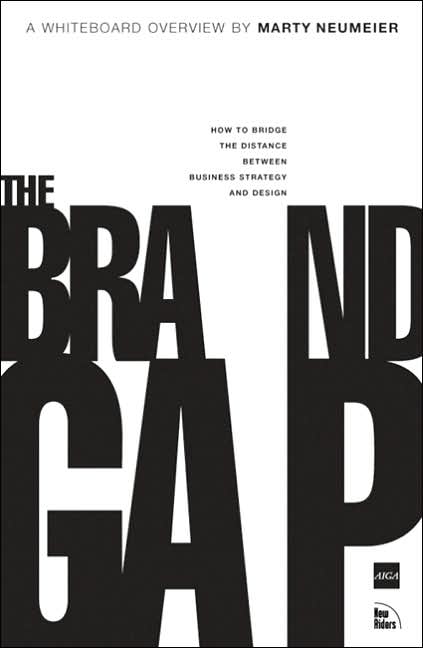
(book review) The Brand Gap

The Brand Gap: How to bridge the distance between Business Strategy & Design by Marty Neumeier
New Riders, NY-USA, 2003


Anyone – be it in the business world, marketing, design, branding or elsewhere realize the power of the word - 'Brand'. Everyone talks about things like branded products, brand identity or brand experience and that a brand defines one's personality or marks one's likes and dislikes. But does everyone really understand what a 'brand' really means? Marty Neumier answers it all for us.

The author gives a new and a practical definition to 'building a brand' while explaining the 5 disciplines of brand building viz. :
1.Differentiate
2.Collaborate
3.Innovate
4.Validate
5.Cultivate

The book runs around all sorts of processes that go in creating, maintaining and growing a brand – the successful and the not-so-successful ones. The book starts from the very basic question: 'What is a brand?' and treads through branding, trends, the tests, problems,  strategy, creativity, names, avatars, designing, packaging, marketing, globalism and evolution of 'brand' to very comprehensive 'take-home' lessons. And these are just a few topics the book talks about.

As they say - “Good things come in small packages”, the best thing about this book is that Marty covers it all in a tiny little book that one can finish reading in a couple of hours. Its like taking a 'one quick pill' for all.

I would recommend this book to anyone with a background in design, business, branding, consumer study, engineering, psychology and anyone who likes to know the story behind brands.

You can view a presentation on the book by the author –  The Brand Gap
Its a huge presentation but worth a watch!