Sunday, January 30, 2011

(book review) Designing Brand Identity


Designing Brand Identity (3rd edition): An Essential Guide to the entire Branding Team by Alina Wheeler
John Wiley & Sons, NewJersey-USA, 2009


Designing Brand Identity is indeed an essential guide to the entire branding team – one of a kind book – theory blended with practical examples from the market. It is a step by step guide to the brand identity process. I believe it is a must have guide!

The book takes us through the basics of brand identity to processes like research, design, strategy to the best practices in the business – locally and globally through some live examples. The book has beautiful quotes from an array of experts in the design, strategy and branding field. 


I am a designer interested in learning and working on branding projects. This book gave a detailed picture of the entire process of brand identity. I found the book a easy read - has short, bite-sized paragraphs, underscored with visual examples. It is more like a  textbook – organized chapter by chapter – you can read sequentially or read any particular concept you want.


It is a must read for designers interested in the branding arena, makrketing people or just anyone interested in knowing what goes behing the scenes while creating a brand.

Monday, January 17, 2011

(book review) Spent

Spent: Sex, Evolution and Consumer Behavior by Geoffrey Miller
Penguin Group, NY-USA, 2009

Geoffrey Miller is a evolutionary psychologist and is the author of 'The Mating Mind'. In 'Spent', the author applies the principles of evolutionary psychology to today's consumer culture. He examines the consumer culture from the lens of a psychologist and reasons as to why we buy the things we do and what factors help us make a purchase. He states that the things a consumer buys is a strong indicator of his/her personality and that the things people buy, display or associate with exhibit our desirability to mates, friends or family members.

He starts from the basic human instincts and examines the shopping psychology of people from all age groups and stratas.  He reasons why people purchase the products they do, why some products appeal to a certain section of people and why they fail with others. He reasons why revamping a product or brand attitude, or a certain advert affects the sales of a product.  He infers messages that people give out when they buy a certain brand/ product – For example: People who buy a Honda are cautious people whereas people who buy a Lincoln prefer tradition. He tells us why people like to be associated with certain brands, why some brands become aspirations and why some brands go down the drain.

Though this book is a easy read and entertaining, it feels highly academic in few of its parts. Miller complains that the consumer culture is not really analyzed from a psychologist's point of view – a thing that is necessary in addition to the market research and consumer insights. He goes into great depths to analyze today's American shopping scenario and to discuss various human traits that are evident in shopping as well as mating.

Overall, the book is interesting and I like the way Miller peels layer by layer the human psyche and the consumer culture. The book is gripping and thought provoking. It is a book that will keep one thinking for a long time after reading it. Moreover, Miller has a great sense of humor and I liked his writing style. After reading so many books on consumer behavior from branding, advertising, marketing, economic and design points of view, this book is really refreshing!

Thursday, January 6, 2011

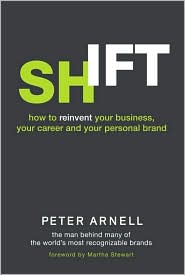
(book review) SHIFT

Shift: How to reinvent your business, your career, and your personal brand by Peter Arnell
Broadway Books, NY-USA, 2010

A book by Peter Arnell – one of the gurus in the branding and advertising business. He has worked on top notch brands such as DKNY, Reebok, Chanel, Banana Republic, Pepsi and the list continues. Shift is about re-branding brands and re-branding oneself. Arnell intervenes his professional and personal experiences throughout the book to give a new and positive outlook on our lives at the same time discussing stories about brands he has worked on.

I was specially interested in reading about the way Arnell interprets and develops new stories for his brands and the way he applies similar techniques to his personal life. Arnell believes that branding starts with YOU. The story of his weight-loss from 460 pounds to 150 pounds is compelling. The book is about 'Shifting' – your attitude, your thoughts and thus your personal brand, your business or your career.

The book has a personal tone that makes the book enjoyable. Arnell talks about the way he learnt about himself and his patterns and pro-actively changed his habits that helped him achieve the feat of weight loss. But, I wish he had given more insights into the business of branding and advertising. Perhaps, he may write another book just on branding techniques.

The book is a quick read, with about 200 pages. I would recommend this book to anyone who wants to get a new outlook towards one's life or to anyone in the advertising, branding and marketing business and of course to all the people who want to lose a lot of weight! After all, its all about making the SHIFT.

Monday, December 20, 2010

(Ruta Writes) …The sign of time…

Creative Re-use of the old and the Worn

Just imagine…old timber, rusted iron, an old bridge, an abandoned house, cracked glass, worn off paint on a wall, faded colors on a fabric…or imagine a old space with aged materials with no one to look after it except for some spiders and a few rodents. “THROW THEM AWAY!!” is what comes to your mind at the first glance.

But, I thought of giving them another glance and my mind just raced through these pieces of living history as any other designer’s mind would. I set out on a journey to see old materials around me not in a journalistic manner but in a designer way. Would these materials be of any use to me? As I kept on thinking about these ‘dying’ pieces, a question struck my mind… “Why do we say these materials are dying?” Human-beings also grow, from babies to toddlers to teenagers to youth to their middle-ages and finally become ‘old’. But we never say that “they are dying”….we say…”they are aging”. This further evoked a few questions…Is this process of aging just a way to decay? Is it a journey to beauty?? Or is it just the effect of time? Or is it something more…

The Alive thrives on the forgotten
Think about these 3 words – Neglection, Action and Reaction. What is neglection? Neglection is an action in itself. When you neglect something, you actually perform an action on the object that you do not pay attention to it. And as it is rightly said – ‘Every action has a reaction’ – With time passing and the action performed on it, the material submits itself completely to time and this, is the process of aging. Elements like air, water, humidity and microbes in addition to time affect it and the material starts changing its appearance. In general terms, the material looses its worth…but it gives a ’food for thought’ to the designers. With times changing, people have started realising the worth of these ‘aging beauties’. A few ‘oldies’ -  the rough, the worn, the dark, the mysterious go well with the ‘youth’- the sparkling, the polished, the bright, the new. The contrast of appearance that time creates on them, gives such a combination a wide appeal.


After thinking about all this, whenever I look at an old material, I can’t avoid giving it another glance. My mind wanders through the entire process again trying to figure out the sign that time has left on them. I ponder whether every person or every designer will perceive the same material as I will? The answer was obviously ‘NO’, the sole reason being that we all are uniquely situated biological beings on this planet. I collected a few things that have lost their original purpose and also a few pictures that can be perceived as something different by every individual.

The most striking thing that caught my attention in the old beauties was the play of colors and the varied pattern of textures that these materials possessed. The picture on the side is that of a rusted, worn piece of metal. The same object when new would have been something that possessed a homogeneous color and texture. The texture…the peeling-off of layers, the unevenness created on a surface that once boasted of its smooth finish makes me wonder how influential the effect of time can be. The diverse colors that the same object now displays after aging, is enormous. Out of curiosity, I tried to separate out colors that this new palette now displayed. Do you even think…this heterogeneous combination is that of a single metal piece? Looking at such a site evokes a few questions…is this a link to the past? Do these materials tell us any story?

To further investigate this question, I learnt about creative reuse of buildings and the reasons for their appeal. As stated by Prof. Derek Linstrum in his lecture series at York institute for advanced architectural studies, there are 5 reasons for appeal of old buildings –
1.Archaeological
2.Aesthetic
3.Economic
4.Functional
5.Psychological

THE REAL LIMITATIONS ARE NOT ARCHAEOLOGICAL, AESTHETIC, ECONOMIC OR FUNCTIONAL, BUT PSYCHOLOGICAL: THE LIMITS CREATED BY PRECONCEPTIONS, AND BY LACK OF IMAGINATION. ONCE THE WILL IS THERE, THE SKILLS AND INGENUITY WILL FOLLOW.
(Ref: Creative Reuse of buildings – Volume 1 by Derek Latham.)

    As I have always thought –

It may not be reasonable at times to recomburse the old…
But it is definitely worth taking the effort!!


Monday, November 15, 2010

(book review) Drive

Drive: The Surprising Truth about what motivates us by Daniel H. Pink (Audio book)
Penguin Audio, NY-USA, 2009

'Drive' begins where 'A Whole New Mind' (Pink's previous book) left us. This “business” book is based on 'human motivation' and discloses the disparity between what we already know as a science but what we actually do in reality. It contradicts the traditional extrinsic motivation and puts a convincing case in favor of intrinsic motivation. It involves more than giving out bonuses to employees or getting good grades.

In addition to the basic biological and response drives, humans have a  third drive - intrinsic motivation. Pink says that, in order to succeed, business need to catch up with this drive.

Pink uses the analogy of computer OS to describe generations of 'motivation' in humans. The 1st operating system in humans was based on survival – Motivation 1.0. Its successor 2.0 was built around rewards and punishments and worked fine for routine tasks of the 20th century. But, we need to upgrade ourselves to Motivation 3.0 (which is based on internal rewards and satisfaction) to survive the 21st century.

Simply put, the book says that people will be motivated when they get:

AUTONOMY in their work.
As humans, our default setting is set to autonomous and self-directed i.e. we are Type I (intrinsically motivated) by default. But, traditional (outdated) management settings turn this setting from Type I to Type X (extrinsically motivated). To move back to Type I, people need autonomy with tasks (what), time(when), team(who) and technique (how).

MASTERY
Traditional management settings demand 'compliance' whereas our default setting is 'engagement'. Engagement in a task that leads to mastery over it. This engagement comes with FLOW. Pink says, mastery can be achieved by 3 peculiar rules:
Mind Set (that sees one's ability as infinitely improvable)
Pain (mastery requires deliberate effort and persistence)
Impossible to fully realize (which makes it frustrating and at the same time, alluring)

PURPOSE
Traditionally, businesses function with the sole purpose of profit maximization and have a purpose so long as it doesn't get in way. With  Motivation 3.0, as Pink puts it, “purpose maximization is taking its way along side profit maximization”. This can be achieved through: 
Goals (using profit as a means to reach the purpose)
Words (that express more than just self-interest)
Policies (that will allow employees to pursue purpose on their own terms)

I would recommend this book for people who run a business or people in the field of management. The book gives a fair idea of what motivates not just employees but people in general. It will give a new way to look at getting the best out of people and one's business in general while keeping everyone happy and content.

Friday, November 5, 2010

(book review) Change by Design

Change By Design: How Design Thinking transforms organizations and inspires innovation by Tim Brown with Barry Katz
Harper Collins Publishers, NY-USA, 2009

Tim Brown, CEO, IDEO is one of the most respected figures in the design world and is one of my idols. His book, 'Change by Design', based on Design Thinking, introduces to the various ways in which businesses can integrate design thinking at all levels. Design thinking is not a design method, but an approach to look at things.

The book sheds light on how 'innovations' happen. It breaks the myth that innovation is a light that strikes the mind of the genius. It shows how innovation is a actually a product of a grueling deal and comes out of processes such as story-telling, prototyping, experiencing, etc. Brown goes through his experiences, projects and case-studies at IDEO to explain the concept.

The book starts off with what seems as Brown's favorite example for design thinking: Brunel – the engineer and the Great Western Railway in England. The book is divided into 2 parts, the first one explaining what design thinking is and the second taking us ahead from there. The first part includes the foundation and fundamentals of design thinking. He explains how any person and not just a designer can be a design thinker. He describes a design thinker as a person who is not only creative but can think creatively, in a non-linear fashion, is exploratory by nature. Brown looks at bridging the gap between designers and the MBAs.

This is a book not just for designers but for creative business people.

Friday, October 29, 2010

(Ruta Writes...) ... to tread a new path

... to tread a new path

They say that “Once the game is over, the king and the pawn go back in the same box.” It’s something that many of us believe! I feel that this is a saying those fatalist people who believe that all events in life are governed by fate and they are led by their destinies. Few are those gems who stride the path that no one has, seek the light in darkness that no one has ever dared to. I feel... it is not about the destination but more about the journey and the way you live it. Sometimes, it is as simple as - decide to walk and the paths start following. Imagine… one lost in an expanse of grassland of thousands of acres where no one has ever been. There is nothing but the vast spread grassland and somewhere at the horizon, the grassland meets the sky. One decides to walk to seek a human settlement. After walking for a substantial amount of time, if one turns back and sees, for once will he realize that he has marked a way of his own that people might follow. The challenge to seek new roads will be more fun than reaching the destination. One may be known only by what one has achieved and people will look just at the
outcomes. But, only one as a person will know the best parts of his journey. As a designer, I have seen that people and clients get awed by the final and finished products… but at times, I feel that the final product is not as beautiful as the inchoate idea. When designing spaces, the part of the design process where a designer can really reward himself is the creation of an incredible idea… the creation of a path, creation of the set of solutions to an issue, to a space that no one has thought of. The evolving of such an idea sets adrenaline running in a designer’s bloodstream and gives him the spirit to create more… But when such people are constrained and made to abide by some parameters, it is then that the level of the invention starts degrading.

It is very hard to find such a person who doesn’t succumb to any such impediment and prospers. As a student of design, I have listened to many people talk about hows, whats, whens and wheres of design. Most of them talk about design as a subject and a profession to which, I believe no listeners pay any heed. It is always inspiring to hear from people/ designers who not only design as a profession or as a hobby but imbibe it in themselves and make good design, a habit. 

As designers, we have to face practical constraints and come out of them. A classic and a convenient approach to address an issue would be to give out an optimum solution that well fits into the requirements and follows the constraints. But, how will it be to gaze at the solution which would be a mere factitious beauty that we have created? Thinking from a different point of view, and the changing perception of design from mere decoration to a strategic step, where a designer becomes a path director, a manager, a strategist, a economist and other endless positions, could we say that we could just not give out solutions to people but, advise them what to do and then surprise ourselves with the varied outcomes? Could this kind of a vision be translated into reality? Can we just raise people’s aspirations and leave them on their own to make them realize what they really want? Can we as designers believe in ourselves so much that we boost people’s understanding about what they really want and be sure that people accomplish their solutions? Can we just go one step ahead of optimists and be leaders who direct the masses? Can we be content just to point the way and not actually walk the path but still be able look back only to find that we have actually come a long way over the lonely grassland?