Friday, February 25, 2011

(book review) Reality Check


Reality Check: The irreverent guide to Outsmarting, Outmanaging, and Outmarketing your competition by Guy Kawasaki
Penguin Group, NY-USA, 2008

I have always admired Guy Kawasaki for his thoughts and ideas. I love to listen to his talks and interviews. This time, I read his book 'Reality Check'. Wonderful book, it is directed towards those souls who are trying to shoot off an idea in the business world, trying to run a successful business or for the ones working up their way to make a career.

As always, he is spot-on his ideas and gets directly to the crux without wandering around any unwanted stories or concepts - makes the read easy to grasp. His insights are deep but presented in bite sized chapters. The book is about 460 pages thick and covers a vast arrary of topics like entrepreneurship, commercialization, raising money, planning and excecution, innovation, makrketing, selling, communication, competition, hiring and firing and so on.

Like always, Guy has done it again – some brilliant work!

Friday, February 18, 2011

(Ruta writes...) Designers: Born or Made – that's the question...


I am always intrigued by the very thought if designers are “born” or if are they “made”. When I say designers – I don't just mean the people who do traditional “art”. By designers, I mean people who are creative, people who innovate. These people could be designing businesses, brands, strategies and of course graphics, spaces and products. 

At times it just feels as if they “happen” ... when you see a 'perfect' design – be it a product, a space, a print, a business, a strategy or any other form of art – when its perfect – it brings with it the feeling of being natural and then they say – he is a “born” success or he is a “born” designer...

Just imagine this situation – You are in the business market and about to start your career as a designer/ branding consultant – you give out your business card or other materials to a 1000 businesses. But, you know that it is impossible to get business from each of them. You know that only about a 100 out of those will come to you. – WHICH 100?? Thats fate. 

Just look at the picture on your right – A designer approaches 6 companies/ brands to work with – big or small, near or far. The business only happens when one of the companies in return wants to hire the designer. This is fate – to get a project to work on. Be it (project) small or big, that is an opportunity. Fate has played its part and its your turn now. What happens later is the MAJOR part that decides whether or not the designer will be acclaimed as being a “born” designer. This part is the actual work. The arrow from the company to the designer is just a matter of choice, something that the designer cannot control. But, he can control the part after that – to give his best shot to the work he has got – of course he should have some talent, he must work with PASSION, put in hard-work and persistence. As Edison once said “Genius is 1% inspiration and 99% perspiration” – so is the case with design.

Good projects do not make great designers. But, hardworking, PASSIONATE, persistent and talented designers make any project they work on – great and end up being perceived as “born” with talent. That is why I like to say - no one is a “born” success or a “born” designer – they are outcomes of hard-work, passion, talent and persistence. 

Thursday, February 10, 2011

(Ruta Writes...) books that made me think...

I am writing this as a reply to someone who asked me about which book I really liked... or which author I feel makes me think the most.

As far as the 'Business' domain is concerned, I like to listen to and read Guy Kawasaki. He writes and talks simplistic - but his thoughts hit the right target - spot on. Currently, I have been reading Seth Godin's book called Linchpin - and now I have started realizing why people like him so much! I have read many books on design, strategy and branding - Many of those were by people I really admire - Were educating. These books taught me a lot about the actual practice of design business - They introduced me to some of the finest and innovative projects. But there was one book that really made me think and change my perception:

Wired to Care by Dev Patnaik
We always hear or read 'be human' in your designs or 'think about the customer first' or at times giving a 'personalized experience'. This is easy to read in books, to say and to talk about. Solving real world issues by design and applying these principles at the same time, is always a hard task. At times, designers go clueless about bringing in the human factor. Dev Patnaik clears the clouds around reaching to your end consumer with a human hand - through design, branding and strategies - He likes looking at any problem through the lens of EMPATHY. It is one of the books that changed my perception about creating great brands. They do not happen - they are created through EMPATHY.

Also, I liked one of my recent reads by Alina Wheeler  (look below for the review)
She goes through the entire branding process in her book - It feels like a textbook and I like the way she goes about describing all the processes with the help of graphics, quotes and "some text". I feel this book is an important one because no one at school or in our professional careers teaches us the A-Z of the design/ branding process - You have to learn it by yourself. I feel if the entire process is taught to all the design students right from the very start - be it any discipline, I guess the interaction between teams at work will be more close and harmonious and there will be no "new discoveries" at work

I just cannot write enough about the authors, designers or strategists I like. But a few others apart from Dev Patnaik, Alina Wheeler, Guy Kawasaki, Seth Godin are Marty Neumeier, Tim Brown, Hartmut Esslinger, Tom Kelly and the list doesn't just end there. I have still a lot more to read, learn, to do and to explore. The next book on my to read list is 'Brand Identity Essentials' by Kevin Budelmann, Yang Kim, and Curt Wozniak.

Friday, February 4, 2011

(Ruta Writes...) Defining - Designer

At times, it is really hard to define what design is. We design (verb), we look at a great design (noun). I tend to get caught in the very notion of finding a definite and exhaustive meaning for the word DESIGN. 

The Merriam-Webster dictionary defines design (verb) as : ‘to create something’, ‘to devise’, prepare a design’ and design (noun) as ‘a deliberate undercover project or scheme’, the arrangement of elements or details in a product or work of art’. Nothing describes perfectly what we, designers do.  And hence it becomes even more difficult to define a ‘DESIGNER’.

I have put together some thoughts about who a designer is – though not exhaustive, it pretty much sums up who a designer is and what he does.  I feel, a designer is a person who creates. Ideally, he/she is a person who is adept at going into others shoes and be the other person – be it an engineer, a doctor, a chemist, a businessman, a consumer or just any person walking on the street and understand them – including their feelings, needs and desires, their problems, their issues about the world around them and devise methodologies and get solutions in order to make lives comfortable and interesting.  This solution could be in the form of a product, a space or an experience – it could be an improvement on the existing scenario, or be an entirely new solution. This solution would ideally be one that would solve the existing problem without creating a new one, be aesthetically pleasing and at the least, sustainable.

Sunday, January 30, 2011

(book review) Designing Brand Identity


Designing Brand Identity (3rd edition): An Essential Guide to the entire Branding Team by Alina Wheeler
John Wiley & Sons, NewJersey-USA, 2009


Designing Brand Identity is indeed an essential guide to the entire branding team – one of a kind book – theory blended with practical examples from the market. It is a step by step guide to the brand identity process. I believe it is a must have guide!

The book takes us through the basics of brand identity to processes like research, design, strategy to the best practices in the business – locally and globally through some live examples. The book has beautiful quotes from an array of experts in the design, strategy and branding field. 


I am a designer interested in learning and working on branding projects. This book gave a detailed picture of the entire process of brand identity. I found the book a easy read - has short, bite-sized paragraphs, underscored with visual examples. It is more like a  textbook – organized chapter by chapter – you can read sequentially or read any particular concept you want.


It is a must read for designers interested in the branding arena, makrketing people or just anyone interested in knowing what goes behing the scenes while creating a brand.

Monday, January 17, 2011

(book review) Spent

Spent: Sex, Evolution and Consumer Behavior by Geoffrey Miller
Penguin Group, NY-USA, 2009

Geoffrey Miller is a evolutionary psychologist and is the author of 'The Mating Mind'. In 'Spent', the author applies the principles of evolutionary psychology to today's consumer culture. He examines the consumer culture from the lens of a psychologist and reasons as to why we buy the things we do and what factors help us make a purchase. He states that the things a consumer buys is a strong indicator of his/her personality and that the things people buy, display or associate with exhibit our desirability to mates, friends or family members.

He starts from the basic human instincts and examines the shopping psychology of people from all age groups and stratas.  He reasons why people purchase the products they do, why some products appeal to a certain section of people and why they fail with others. He reasons why revamping a product or brand attitude, or a certain advert affects the sales of a product.  He infers messages that people give out when they buy a certain brand/ product – For example: People who buy a Honda are cautious people whereas people who buy a Lincoln prefer tradition. He tells us why people like to be associated with certain brands, why some brands become aspirations and why some brands go down the drain.

Though this book is a easy read and entertaining, it feels highly academic in few of its parts. Miller complains that the consumer culture is not really analyzed from a psychologist's point of view – a thing that is necessary in addition to the market research and consumer insights. He goes into great depths to analyze today's American shopping scenario and to discuss various human traits that are evident in shopping as well as mating.

Overall, the book is interesting and I like the way Miller peels layer by layer the human psyche and the consumer culture. The book is gripping and thought provoking. It is a book that will keep one thinking for a long time after reading it. Moreover, Miller has a great sense of humor and I liked his writing style. After reading so many books on consumer behavior from branding, advertising, marketing, economic and design points of view, this book is really refreshing!

Thursday, January 6, 2011

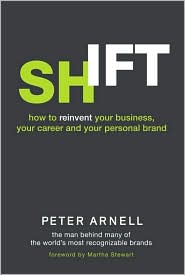
(book review) SHIFT

Shift: How to reinvent your business, your career, and your personal brand by Peter Arnell
Broadway Books, NY-USA, 2010

A book by Peter Arnell – one of the gurus in the branding and advertising business. He has worked on top notch brands such as DKNY, Reebok, Chanel, Banana Republic, Pepsi and the list continues. Shift is about re-branding brands and re-branding oneself. Arnell intervenes his professional and personal experiences throughout the book to give a new and positive outlook on our lives at the same time discussing stories about brands he has worked on.

I was specially interested in reading about the way Arnell interprets and develops new stories for his brands and the way he applies similar techniques to his personal life. Arnell believes that branding starts with YOU. The story of his weight-loss from 460 pounds to 150 pounds is compelling. The book is about 'Shifting' – your attitude, your thoughts and thus your personal brand, your business or your career.

The book has a personal tone that makes the book enjoyable. Arnell talks about the way he learnt about himself and his patterns and pro-actively changed his habits that helped him achieve the feat of weight loss. But, I wish he had given more insights into the business of branding and advertising. Perhaps, he may write another book just on branding techniques.

The book is a quick read, with about 200 pages. I would recommend this book to anyone who wants to get a new outlook towards one's life or to anyone in the advertising, branding and marketing business and of course to all the people who want to lose a lot of weight! After all, its all about making the SHIFT.